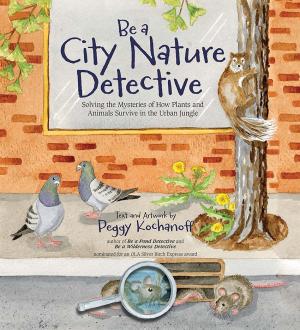
Be a City Nature Detective: Solving the Mysteries of How Plants and Animals Survive in the Urban Jungle
Have you ever wondered how plants and animals survive in the concrete jungle of the city? Peggy Kochanoff’s Be a City Nature Detective explores the mysteries of how a variety species and organisms, from bedbugs to coyotes and burdock seeds to ginkgo trees, have adapted and are able to survive in urban settings.
The book is structured in a call-and-response format, where one page invites the reader in with a question and the answer is provided on the next. We learn how 16 different species can be found co-existing with us in the urban environment.
Not only does this text investigate how certain beings have adapted to survive in cities, but it also teaches readers about different species. We learn what they look like, where they grow/live, what the animals eat and where the plants originated. The book wraps up with a comparison between the night sky in the country and the city.
Kochanoff has illustrated this book with beautiful, eye-catching watercolour images. However, if the book is meant to help readers identify plants in the city, the illustrations are not realistic enough. Looking at the images could provide the opportunity for students to research and compare photos of the real plants with the illustrations and discuss similarities and differences. The illustrations could also be used as an introduction to teach watercolour painting in visual arts. Students could look for examples in the text where Kochanoff has created different textures or added shadows and depth using paint.
While there are many connections to the Grade 2 (Growth and Changes in Animals) and Grade 3 (Growth and Changes in Plants) Science curriculum, the vocabulary in this text could be too challenging for Primary grades. It looks like a picture book but reads more like a textbook, and could in fact serve as a good introduction to textbooks for students, as it does have bolded terms throughout and a glossary at the back. This book is filled with information, from cover to cover.
Tina Buttineau is a member of the Bluewater Teacher Local.