Building Our Future
In the spring of 2025, one of my Grade 4 students reflected on how old he would be in 2100, and whether he would be alive. I replied that yes, I did think he would be alive, and we calculated that he would be 85. But then, to myself, I wondered, “What will the world look like in 2100?”
To say that we live in uncertain times is an understatement. Climate change, rising fascism, artificial intelligence, increased income inequality, genocide, war, eroding democratic systems – these are just some of the extreme world events that continue to overwhelm us with pictures of a planet in turmoil. In fact, we are in a “permacrisis,” a term coined just after the pandemic by Collins Dictionary to describe “an extended period of instability and insecurity, especially one resulting from a series of catastrophic events.”
Faced with inheriting a world in chaos, there is little wonder that young people are increasingly struggling with their mental health. Information from the 2022 Health of Young People in Canada: Focus on Mental Health report indicates that feelings of hopelessness and sadness are on the rise. The report, developed by the Public Health Agency of Canada, used extensive surveys of young people across Canada to research trends in mental health.
The results are startling: for Grade 8 cisgender girls, feelings of being sad or hopeless almost every day for more than two weeks increased to 46 per cent in 2022 from 24 per cent in 2010; for Grade 8 cisgender boys, the increase was to 21 per cent from 14 per cent over the same period.
Self-identification as transgender or gender-diverse were not options in surveys conducted prior to 2022, but results of the latest survey show poor well-being was reported by 70 per cent of transgender youth in Grades 6 to 8, as well as by 41 per cent of cisgender girls and 20 per cent of cisgender boys. Reasons for these increases are complex (e.g., the COVID-19 pandemic, social media), but also include the climate crisis.
Personally and professionally, I have thought about our future world a great deal. It is reasonable to have a high level of anxiety about what the planet and political systems will look like for our students as they grow up. It is easy to feel overwhelmed by the state of the world. Yet, as a climate activist, organizer and educator, embracing hope for the future is essential. Developing a mindset of optimism – and then taking the steps necessary to create a future world that is sustainable and just – is not only invigorating and motivating but an act of resistance. Having a sense that we are in a bleak moment in history but knowing that history goes through waves of very challenging times gives us a sense that if we work together, we can change the world for the better.
Sustainable Future Community
With all this in mind, last year I developed a unit for my Grade 4/5 class that embraced design thinking to create a sustainable future community that relies on renewable energy. This was a creative group of students who liked to think outside the box. Giving them a hands-on task that integrated multiple subject areas and learning skills was a great opportunity for them as students and for us as a community.
Science Integration
Anyone who has ever taught a split-grade class knows it can be a challenge to balance the curriculum needs of both grades. An effective strategy is to combine the instructional tasks as much as possible. For this project, I combined the Grade 4 Light and Sound strand with the Grade 5 Conservation of Energy and Resources strand. We investigated solar power, specifically how light energy travels from the sun and how solar panels transform the sun’s energy into clean, renewable power.
It’s exciting to find connections between different subject areas, social justice goals, and learning skills. As education becomes progressively more challenging, looking for the beauty within integration is energizing. Understanding and incorporating concepts creates a rich, discussion-oriented classroom. For example, learning that light travels from the sun to the earth in eight minutes and 20 seconds, and that that energy powers our lights and feeds our electric grid, all while sustaining life on earth, is amazing.
Sustainable Development Goals
An aspect of the project that I particularly enjoyed was the incorporation of the United Nations Sustainable Development Goals (SDGs). The 17 SDGs were created in 2015 as a way to support peace and prosperity for the planet, tackling climate change, and supporting life on land and in the oceans. While the goals have had some limited success, they are an important framework for creating a safe and equitable future. (Learn more at sdgs.un.org/goals.)
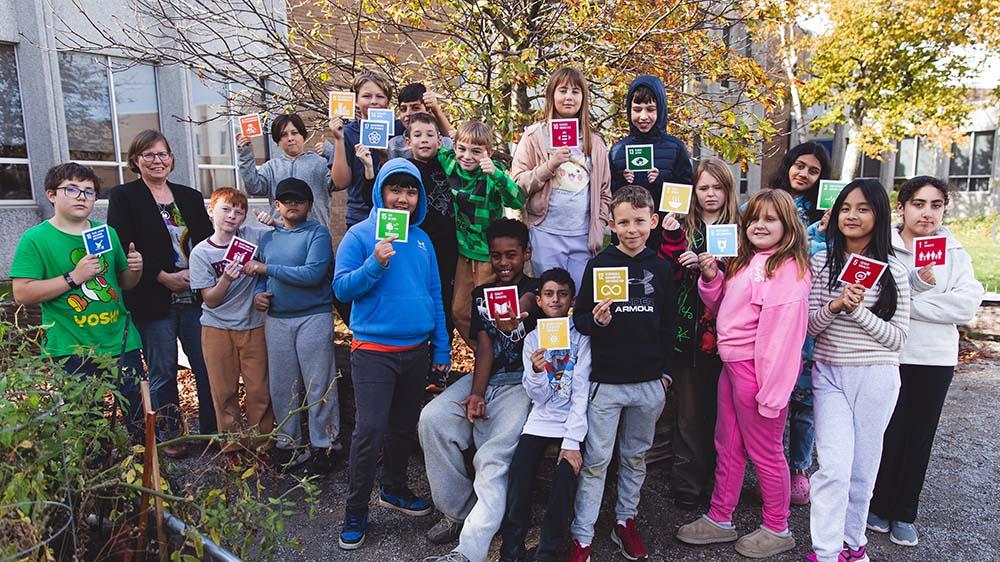
The students were put into groups for this project and were asked to come up with a name for their community. I asked the students to connect their group name to one of the 17 SDGs.
We ended up with the following SDGs and community names:
SDG #1 No Poverty – Wonderville
SDG #2 Zero Hunger – Banana Capital
SDG #7 Affordable and Clean Energy – Solar City
SDG #13 Climate Action – Climate Stars SDG #14 Life on Land – Forest Haven
SDG #15 Life Below Water – Ocean Maze
I taught lessons throughout the year about the SDGs to help students understand how their choices affect the planet and the people who share it. The groups discussed and reflected on the SDG as they created their community, and deep learning occurred. Thoughtful discussions about how an end to poverty could be achieved, or the ways zero hunger could be accomplished, happened within each group.
With their future communities in mind, and keeping the connection to their SDGs, it was a challenge to think beyond current structures and realities. Students reflected on the need to protect animal habitats, forests, and oceans, and learned about energy systems. The SDGs were a helpful framework for the children to understand complex topics about sustainability.
Collaboration
In addition to curriculum expectations, an important aspect of any real-life project is the opportunity to develop learning skills and work habits, as defined in Growing Success, the Ministry of Education’s 2010 assessment and evaluation guide. The sustainable future community we created allowed students to understand and develop collaborative skills.
I applaud the words and thoughts of Nigerian writer and activist Bayo Akomolafe and Salvadoran feminist theologian Marta Benavides, shared in their co-published article The Times are Urgent: Let’s Slow Down (full text available at bayoakomolafe.net). “Though civic efforts have been worthwhile, they have done nothing to change our relationships with the planet, with people, and with ourselves; we are still tethered to the deadening values of consumerism, and have not reclaimed our roles as living co-creators of a society we prefer to live in.
If we beat the system at its own game, we’ve lost. It is no longer time to rush through the contested world blinded by fury and anger – however worthwhile these are. Now, we think, is the time to ‘retreat’ into the real work of reclamation, to remember again our humanity through the intimacy of our relationships. The time is very urgent – we must slow down.”
Our relationships (with each other, with the planet) need to be nurtured, and children need to be taught. Listening deeply to children, teaching them to listen to each other and helping them understand unique perspectives and differences is part of our work as educators.
For this project, I created mixed-grade groups, taking into consideration social relationships, different abilities and special learning needs. I also wanted the students to take on different roles within the group.
The project roles were:
- Project manager
- Designer
- Materials supplier
- Accountant (Grade 5 role)
- Measurer
The communities were each given a $500,000 budget to use to buy their supplies (for example, part of an egg carton cost $3,000; a square Styrofoam slab cost $20,000; a glue stick for a hot glue gun cost $5,000).
One of the Grade 5 math expectations in the Financial Management section is to “design sample basic budgets to manage finances for various earning and spending scenarios,” so I wanted my Grade 5 students to play a leading role. Collaborative problem-solving with financial implications encouraged the groups to really examine their needs. It forced the students to truly listen to each other about what they felt their projects needed and where their community was going.
Materials
I wanted to ensure that the project was based on the use of recycled and reused materials. This was partially to think about how a future world can be created using what we have, but also connected to my own reflection about how our society, including our public schools, create a huge amount of waste.
I collected small boxes and plastic that cannot be recycled. I brought in egg cartons and cardboard and cut up Styrofoam left over from packaging. I had on hand bristol board, balsa wood, popsicle sticks and hot glue guns with the required glue. I also gave students a copy of their printed SDG to physically integrate into their community, so it would be obvious and informative to the audience when they shared their projects.
Creativity
Each group was given a large piece of bristol board on which to create their community. Within it, they needed to have essential services (including food, health, education), a transportation system, recreation, at least one solar panel and sustainable technologies. Sustainable technologies could exist in the present or be created (for example, one group discussed the use of light waves as power and the possibilities of using sound waves as power). Projects also needed to include one three-dimensional building, allowing students to participate in hands-on innovation.
The communities created were all unique, and students were intentional about connecting their community to their SDG. For example, Solar City used both solar rays and wind power to create clean, sustainable energy. Wonderville had a school, café, food bank, a large hill constructed out of Styrofoam, as well as a UFO visiting town. Banana Capital, initially named as a bit of a joke, delved into the issues surrounding hunger and built raised flats for transporting bananas.
Using the information learned, and then working together to apply that learning and do the hard, messy work of creating a sustainable future community was engaging, rewarding and fun. The students loved the project, and their engagement allowed me to circulate among the groups easily, supporting their inquiries and challenging their ideas. My trust in their abilities also deepened our teacher-student relationships and contributed to our classroom community.
Community Showcase
We concluded the project with a community showcase hosted in the school library, inviting other classes to come and see what we had created. Students shared their learning, inspiring other students with our future vision. Significantly, students spoke with pride and enthusiasm about their community’s SDG. They learned that sustainability can be a priority for a community.
I invited parents to attend the showcase, as well as other adults who are part of my community (including former teacher candidates, a retired teacher friend and a community member). I also invited a few superintendents to see what the students had created and accomplished, as a way to celebrate their work.
The community-building aspects of the showcase were notable: students shared their work with a variety of grade levels, and inviting parents and community members deepened relationships. Students also began to see themselves as capable change-makers who can imagine, design and build more sustainable and caring communities for the future.
Touching the Future
Many years ago, when I was a teacher candidate, we were asked to create posters in groups that provided direction for our teaching journey. One of the groups developed a poster that read:
“I touch the future – I teach.”
I never forgot this small pedagogical exercise. Teaching students who will be alive in 2100 is a responsibility, for the lessons taught now will carry them forward. Developing realistic optimism for our planet, and then teaching our students the skills necessary to create that world, is our work.
Jen Reid is a member of the Halton Teacher Local.